

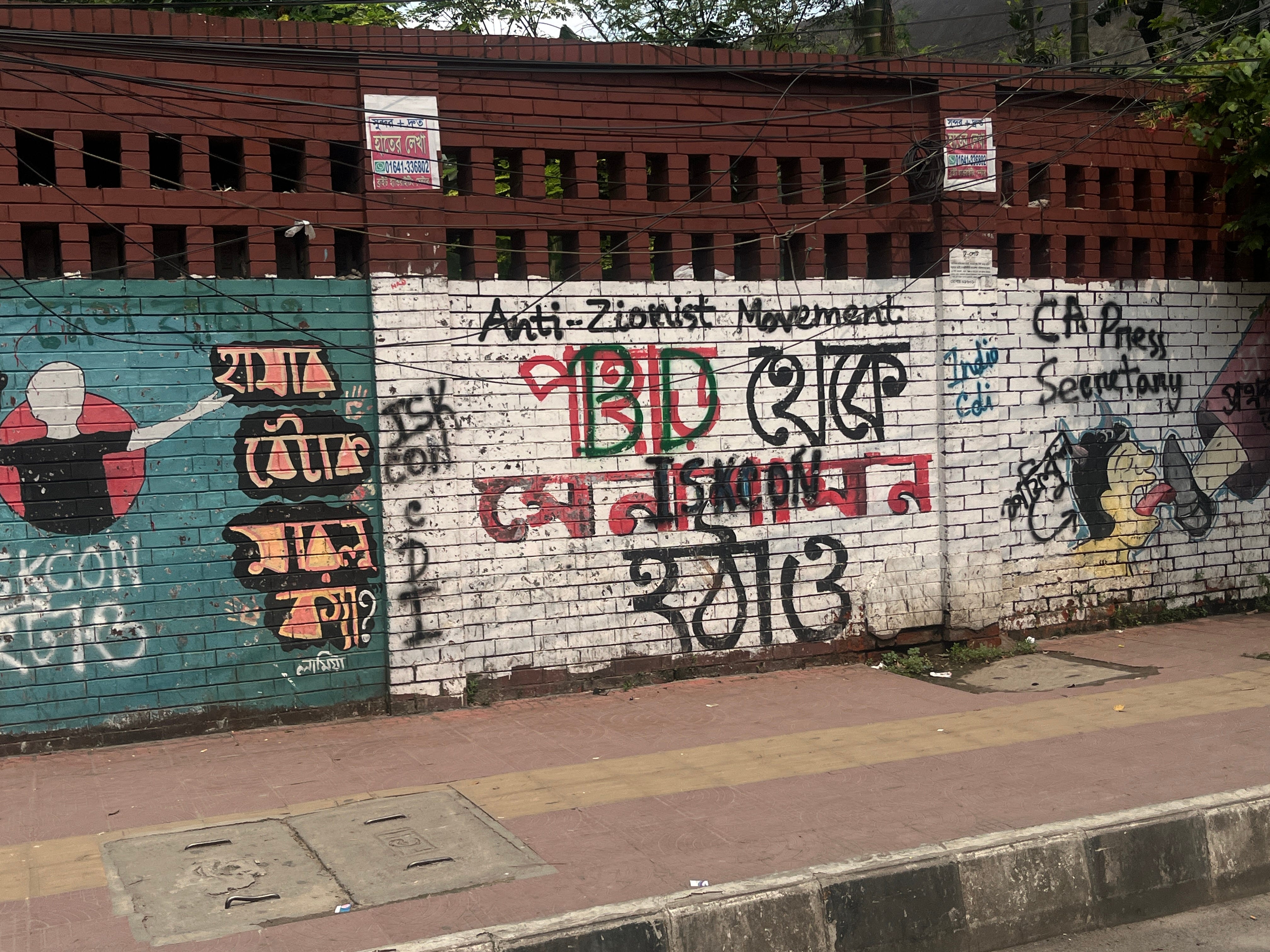
Image: Painted wall in Dhaka.Pic- Ramesh Bhushal
RAMESH BHUSHAL
Dot 6 pm, the plane was on the runway. A rare moment for a Kathmanduite — I don’t remember any recent flight I’ve taken on time. Believe me, I’m not talking badly about my country. It’s a beautiful country, beautiful people — most foreigners say so themselves. So what kept us at the bottom of the world rankings, backward and least developed? Huh. Come on. Let’s not talk about it.
We were heading east, but in Kathmandu, you normally need to make a loop, so we flew north, turned, then headed southeast toward Bangladesh, you could also say India, but Bengalis hate India, so it’s better not to say that for now. I’m going by the words of many Bengalis I’ve met. Sorry, my Indian friends. Maybe they only hate the Indian government. People don’t even love their own governments, who would love someone else’s? Government isn’t a thing to love. It’s a dangerous creature, but one created by the people themselves.
I don’t enjoy flights. I wish there were a bus from Kathmandu to Dhaka so I could drive down south, stop for tea, and talk to people. It’s not that far — just an hour-long flight but getting there by land is brutally hard. Flying around South Asia, I always imagine a trip from Afghanistan to Myanmar, crossing rivers and mountains, eating local food, and listening to music. But it’s a dream that never comes true. Imagine a train from Kabul through Pakistan, the Indian Himalaya, Nepal, Assam, Bhutan or Sikkim, into Myanmar, and onward to Thailand, Cambodia, Vietnam, Laos. A dream of dreams. I sometimes even fear dreaming because if it came true, how would I embrace it?
This region is so divided. Afghanistan is its own world now, ruled by the Taliban. India and Pakistan don’t talk to each other. Nepal is a bit more flexible but isn’t without its problems. India, our common big brother, has no good relations with its neighbors. Myanmar is ruled by the junta’s gun. Bangladesh and Sri Lanka are no better off. We are so messed up. The rivers that originate in these mountains shape our lives; we’re the product of these mountains, yet we can’t be friends at all.
Let’s take off for now. The captain spoke, but I hardly listened. Who listens to those announcements? The rituals.
When you’re on a plane, it’s not worth worrying, but you keep worrying. At least I do. After you take off, either you land, or you don’t; those are the only two possibilities. Easier said than done. You must trust science, or don’t buy the ticket. They say it’s one of the safest modes of transportation. But while I was writing this, a B-52 bomber crashed in California, killing all eight on board, and a crash in France killed over ten skydivers. Let’s not dwell on it. Hope. Hope. Hope.
Clouds were hovering, and the sky was colorful with the setting sun. You think the sky is blue — it is, but it’s also red, orange, black, pink. It’s sad, happy, angry, silent, thundering. It’s better to write “etc.” when you lack the details. A lazy writer does that. Count me in. Snow-peaked mountains showed just their heads, bodies hidden under the clouds — the Himalayas, the tallest range in the world. Majestic, we call them, and then we treat them brutally.
When you’re in the air, you think a lot. Looking at the clouds, the thick snow on those peaks, the rivers flowing endlessly. A drop of water shapes the earth. Sometimes it becomes gas and forms clouds, sometimes it melts and flows, and sometimes it freezes as ice on the rocks. The planet is all about different forms of water, and those drops create different forms of life. We are one of those forms, supported by those drops, and we rarely credit them. We think we’re alive because of our lungs or our heart, but the real supporting systems are outside of us, continuously supplying the fuel we need. We just don’t pay for it directly. We only pay taxes to the government, and we keep changing them.
There are over 8 billion of us on Earth now. On the plane, young Nepali boys — handball players, many on their first flight, were excited about Dhaka. One said, “What if this plane crashes?” Another replied, “You won’t even know because you’ll die before you find out.” What kind of conversation is this? I didn’t ask.
A young Bengali man sat next to me. A passenger behind asked if he could bring his seat forward. He stared at him and said, “You can do also.” I was confused, and so was the guy behind him. I figured out later what he meant: I’m doing what I want; if you want yours upright too, do it yourself. A couple of minutes later, the air hostess made him upright anyway. Man, you’re young, learn a bit. I didn’t say that to him; I said it to myself. As a writer, you talk to yourself a lot. If I’d fixed the problem myself, there wouldn’t have been a story to write. Writers are selfish, people say. I am not.
I got curious about him afterward. He was from Dhaka, had been to Mustang and Nagarkot, and studied English literature. So how does someone like that say “you can do also”? Maybe attitude doesn’t leave much room for learning. That was an unnecessary bit of bad attitude. I didn’t tell him, though.
We reached Dhaka at 7:15 pm, already dark. Dhaka is a city full of stories and life, but also too many stories and too many people. For someone from Kathmandu, who thinks of it as polluted and crowded, Dhaka isn’t even close. I’m not talking badly about it, my Bengali friends, our cities are too filthy. We don’t have manners, and we litter everywhere. We haven’t really built our cities; we’ve built mass shelters. We could have done better. I’m talking about Kathmandu too.
Bangladesh is rich in culture, food, and music. I love it all. What I don’t like is that the country is overpopulated. When I visit overpopulated places like Dhaka or Delhi, I genuinely ask: why do you produce so many kids? Don’t tell me the West uses more resources than us — I know that already, and the inequality is real and unjust. But please, let’s still have fewer people. You can have fun and still have fewer kids. I have one, and I’m fine with it. The real problem, many argue, isn’t population but inequality — fewer people in the West degrade more land and use more water than many in the East combined. Fine, you’re right. Both, too many people and too much consumption are serious problems
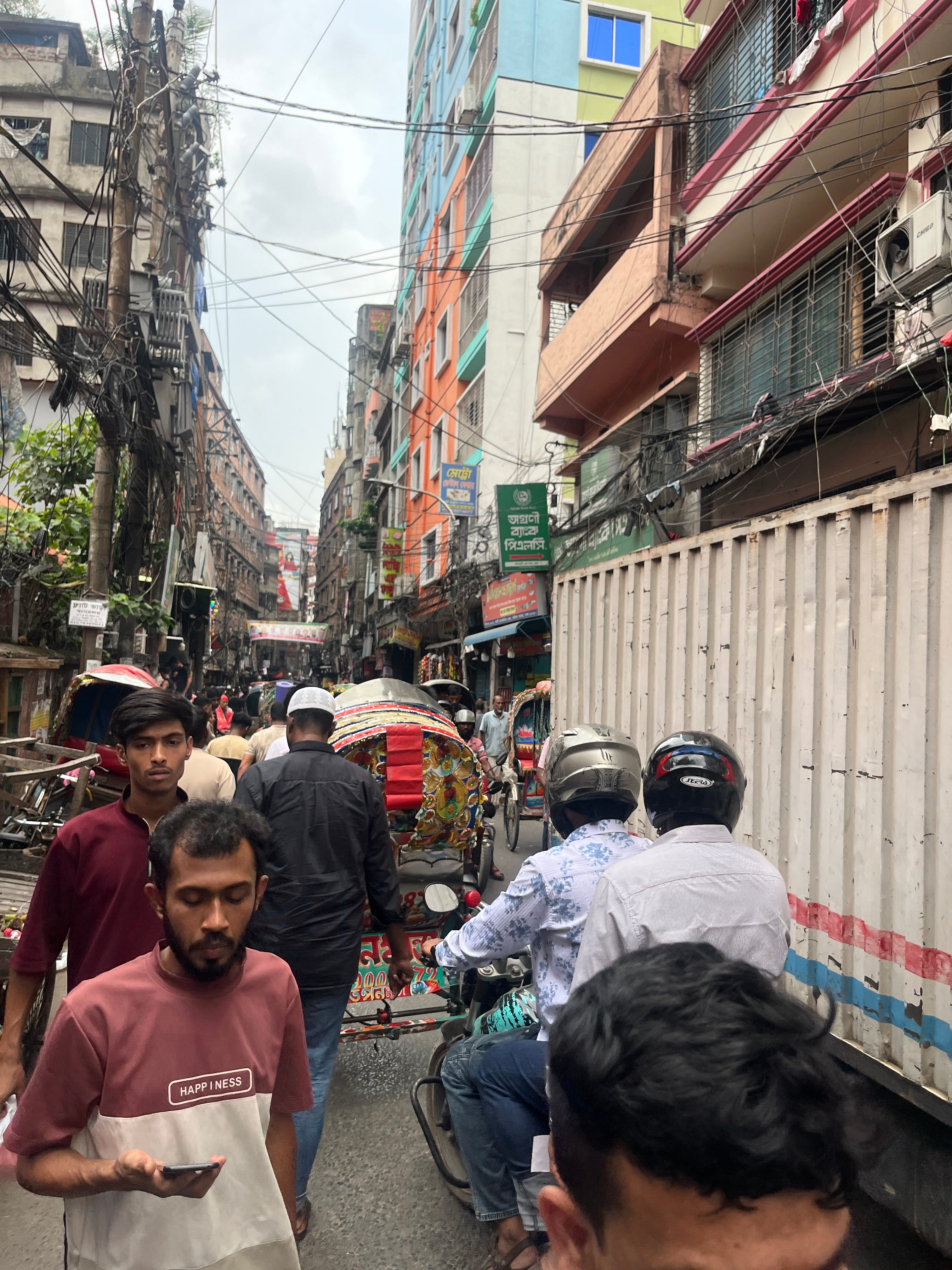
Image: Old Dhaka, Pic- Ramesh Bhushal
At the immigration desk for a visa on arrival, they asked for four things: a passport, an organizer’s letter, a return ticket, and a hotel booking. I was stamped in under five minutes.
Our hotel driver was waiting with my name at the airport exit. I should mention I was invited to Dhaka for a program on rivers, organized by Oxfam. These words I have written here are unpaid, though, so if you’d like to change that, DM me. As soon as I said I was from Nepal, he praised our new prime minister, Balendra Shah — Balen, as people call him, and was especially happy Balen had refused to meet India’s foreign secretary, Mishri. He wasn’t happy with how Bangladesh’s new PM was handling India either. Most Bengalis I’ve met express frustration with India — sometimes I think more than Nepalis do. Either way, we can all agree India doesn’t have great relations with its neighbors.
He got me to the Lakeshore Hotel in Banani in half an hour via the newly built flyover, sparing most of Dhaka’s horrible traffic. I asked him, “Is the new government better than the old one?” He smiled and said, “Same-same.”
Chaos is another name for Dhaka. If you enjoy it, it’s wonderful. Dhaka has over 20 million people — nearly two-thirds of Nepal’s entire population. A newspaper ran an article with the byline of Jannatul Bushra, “ If you try to make of sense of Dhaka traffic only by using logic and Google Maps, you will very quickly realize that the city has no particular interest in cooperating with either of them .”
The Cab driver, too, brought up our Balen, refusing to meet India’s secretary; that news had clearly gone viral. Honestly, it was among my least concerns back home. I was more worried about inflation, the treatment of slum dwellers, fuel prices, and the dwindling stock market. But it’s nice to hear good things about your country and leaders for once. A young man has come to power, and I just hope he won’t end up like the young man on the plane. I think attitude is the biggest risk for our youngest prime minister. You can be a leader and still have a bit of Mamdani in you. I wish he had more of it.
I know we have plenty of differences with India, and India has always tried to micromanage its neighbors, but the neighbors have taken their share of advantage too. I wish India thought more pragmatically about the region so we could all be more prosperous together. But the way I think and the way leaders think don’t converge. Let’s park it here.
Dhaka wasn’t as hot as I expected, as the pre-monsoon showers helped a bit to cool it. This was my third trip to Dhaka, and by now I can say confidently: time is just a number here. Everyone is rushing, but nobody arrives anywhere on time. Say “let’s have lunch,” and someone will say, why only lunch? Let’s start with breakfast, then doesn’t show up even for dinner. I’m not generalizing, but over-promising is a disease across the developing world, and Bengalis are quite good at it — more than Nepalis, I’d say. We’re not different breeds, though.
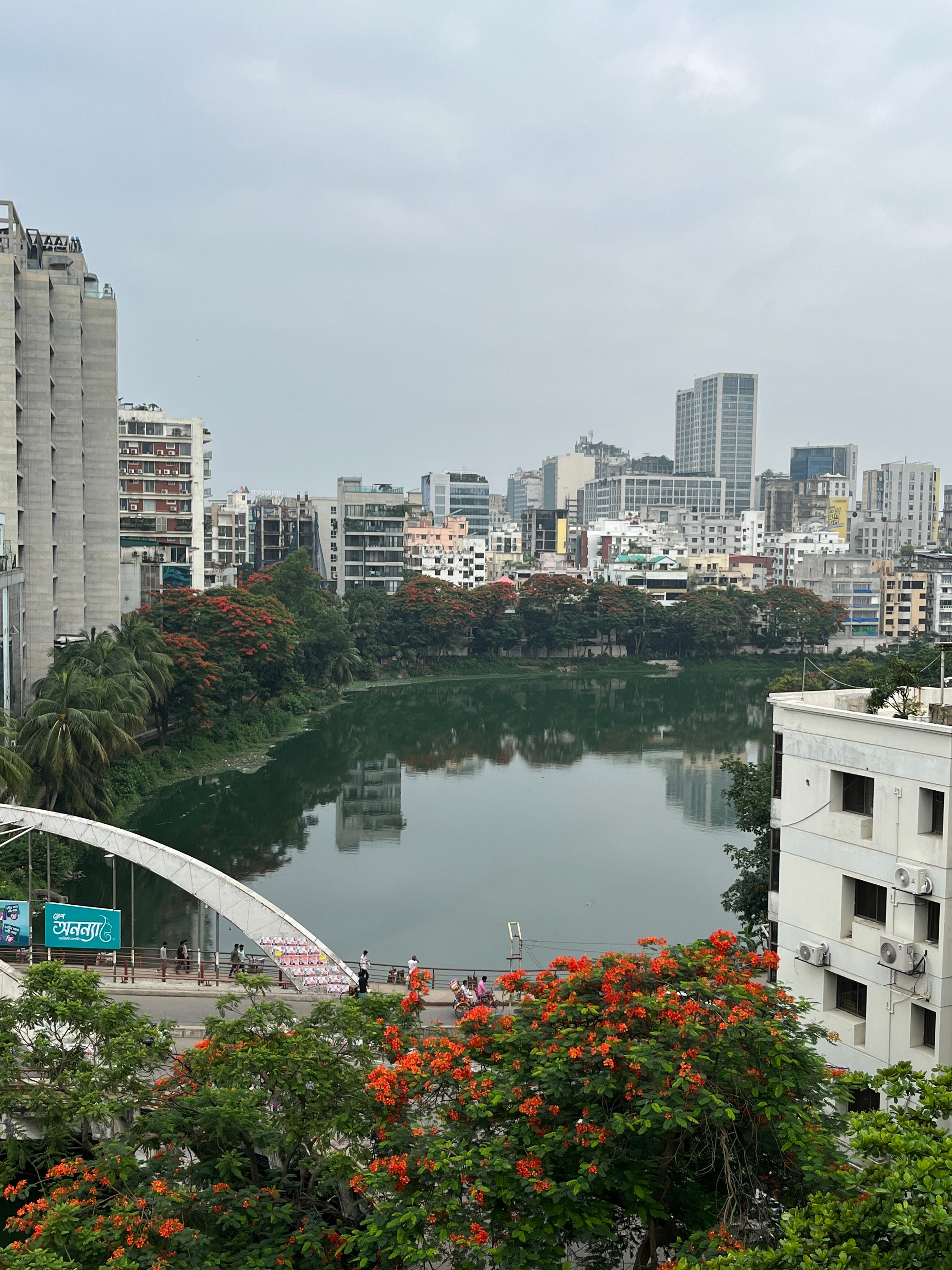
Image: View from hotel Lakeshore in Banani. Pic- Ramesh Bhushal
This time, my colleague Rakib showed up half an hour before our agreed time, unusual enough that I thought Dhaka had changed with the new revolution. But another old colleague, who’d promised fun before I even landed, never showed up in three days. I asked Rakib, too: Is the new government better than the old one? “I don’t think so,” he said. “Same corruption, same way of dealing with things. We want our student leaders to be in power. One day they’ll take over.” One more revolution but no arson, please.
But trust me, Bengalis give you their whole heart as friends. Rakib took me to Old Dhaka and showed me his old classroom at Dhaka University. We took a CNG from Lakeshore to Shahbagh, then a rickshaw. I always feel bad taking rickshaws, watching a fellow human pull two others — such hard work. But then I think, at least it earns him bread and butter.
I caught a glimpse of the Gen Z protest site in Shahbagh, the old martyrs’ memorial, and the hope and dreams of the people who revolted. But is it translating into anything? Many already seem frustrated.
We ate at the famous Hanif Biryani despite a struggle just to get a seat. Not sure what makes it so popular, but it’s more popular than the new government, for sure. To me, it carried a message: focus on one thing, and you’ll get the best out of it. Hanif Biryani serves exactly one dish, mutton biryani, and only mutton biryani.
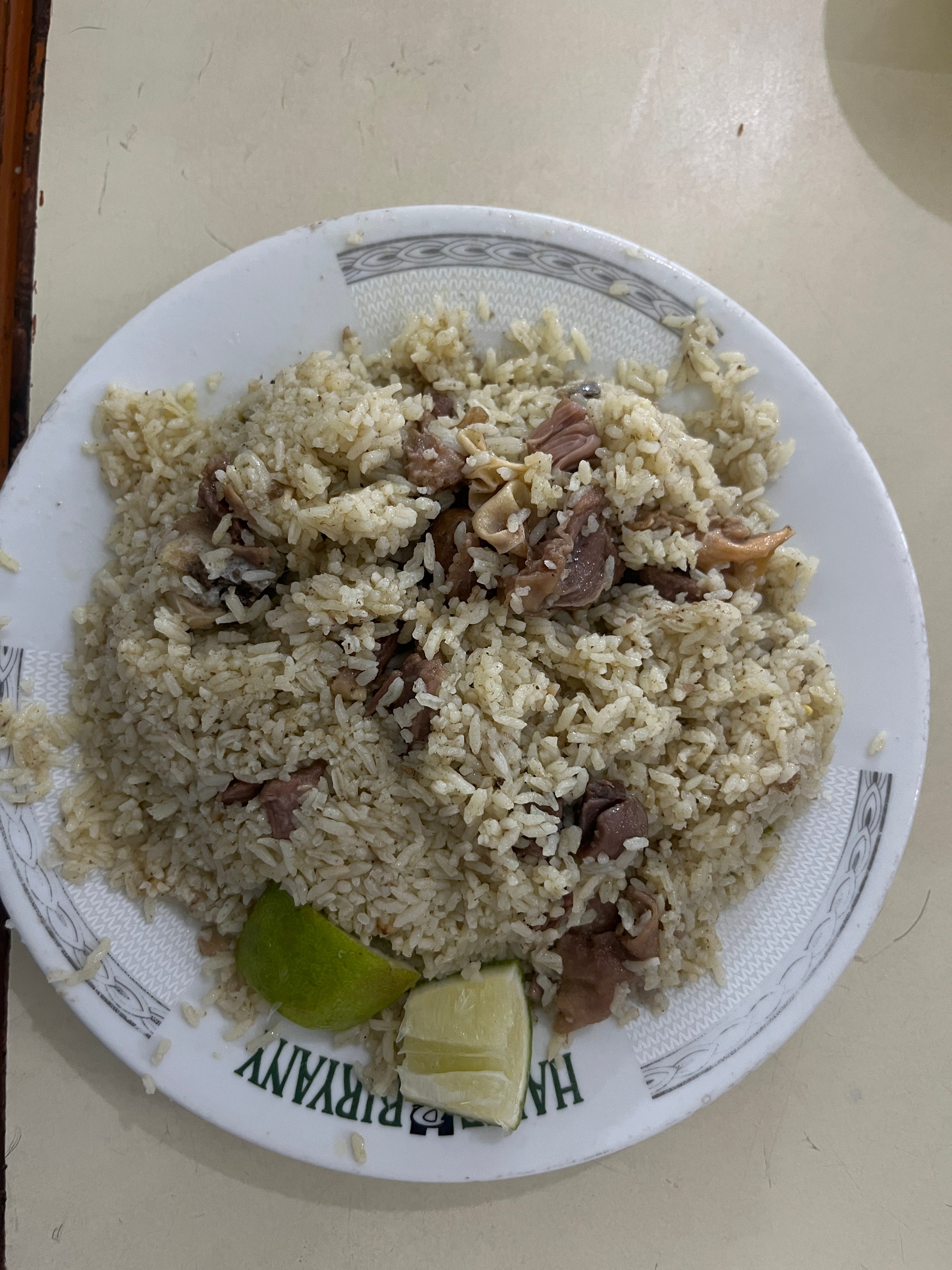
Image: Hanif Biryani in Old Dhaka. Pic- Ramesh Bhushal
We came back to the University area and got into the Prothoma bookstore. I bought four books. For a store run by the country’s largest newspaper owner, it wasn’t that impressive. I’d expected somewhere you could stroll for hours with a real range of books. I bought Tagore’s Gitanjali, Kafka’s Metamorphosis, Marx’s The Communist Manifesto, and Milton’s Paradise Lost. Four books came to 1,400 taka total. The counter gave us a receipt for just one book, around 300 taka — the rest untaxed, apparently. Small things like that, compounded, are how a country starts to fail. The bigger problem, though, was that Rakib wouldn’t let me pay for any of it. “When you’re in Dhaka, it’s my responsibility to make you happy, no money from your side,” he said. I tried and failed. I only managed to pay 50 taka as a tip to the rickshaw puller.
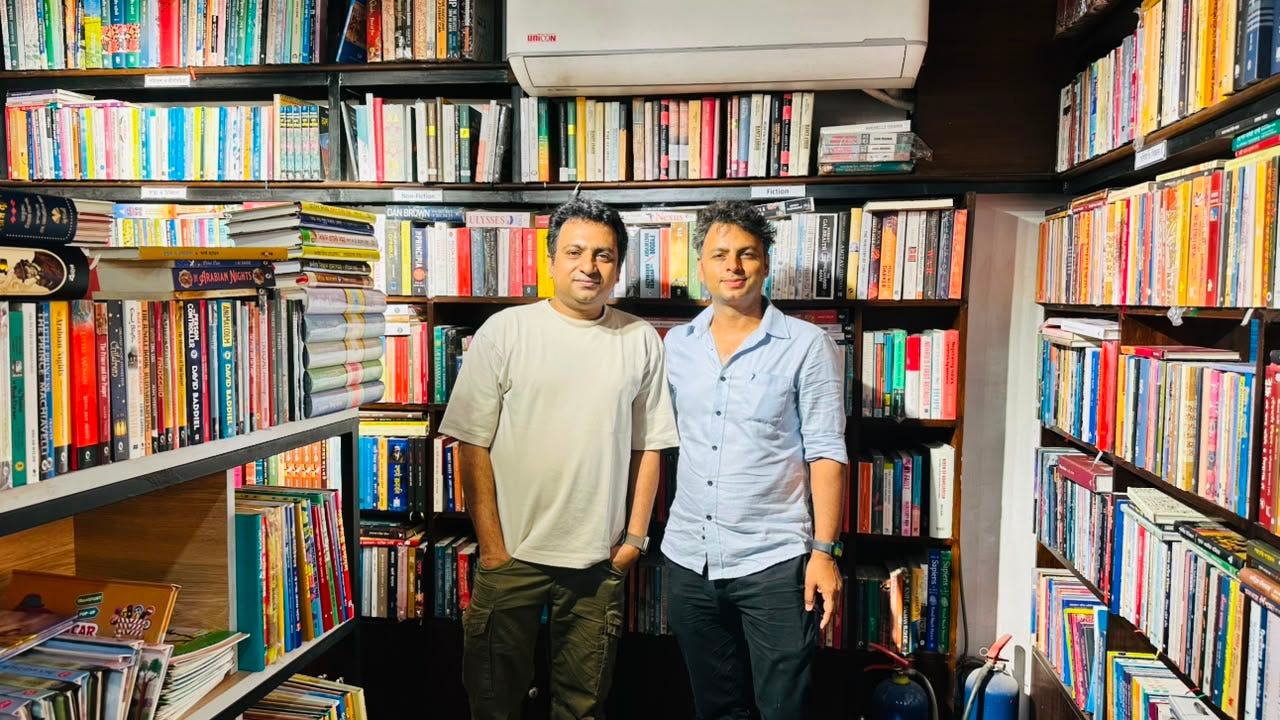
Rakib and I are in the Prothoma book store in Dhaka.
It’s okay, my friend. I’ll do something for you when you’re in Kathmandu. It doesn’t need to be much. I’ll take you to the hilltop, buy a couple of beers, and show you the mountains. The beers on me, the mountains will do the rest.
One day, I walked out of the hotel just to look for clothes — Bangladesh’s other name might as well be Cloth-desh. I found a big store called Big Boss in Gulshan and bought a ton, total under 300 dollars — branded clothes with unnoticeable factory defects, or so I was told. I got hungry and asked the manager for a good place serving Bengali food. It was raining; he kindly sent an assistant with an umbrella to walk me to the restaurant — Sultan’s Biryani, of course. Let’s just rename Dhaka already. Like momos in Nepal, biryani is the thing in Dhaka. The portion was so large I had to pack half of it for dinner. I’ve survived many days without proper food in my past life, so biryani, to me, is a luxury. I ate at night too.
I asked for bedding, and the same manager walked another ten minutes with his umbrella to show me a store I hadn’t even asked for. For a moment, I felt like Elon Musk. The rickshaw back to Banani cost 50 taka. The puller was an older man, so I gave him 100 and didn’t ask for change. He gave me a big smile — cheap, I thought, to buy a smile like that. You just have to know who not to bargain with.
I didn’t see much of Dhaka this time. A couple of days isn’t enough to explain a city like this, but it wasn’t my first visit, and I think I know it a little. So much hope. So much hard work. So much poverty. So much pain. Bengalis are desperately waiting for better days, but governments don’t think that way — they think about how to win and keep winning. Hope this government won’t do the same as the earlier one.
But once, Bengal was the richest place on Earth. In the early 1700s, it generated roughly 5% of global GDP, and its capital, Murshidabad, held more wealth than the British aristocracy combined. Historian Sam Dalrymple has written about how foreign trading companies competed for the favor of the Bengali elite, and how a forty-mile stretch of river once hosted trading posts from five European empires at once. In the three centuries since, it’s gone from richest to one of the poorest. By the way, I read this post on Sam’s Substack post.
Will those old days return to Dhaka? I don’t know. But if they do, I’m sure Kathmandu will benefit a little too. Until next time, thank you, Dhaka. Don’t lose your hope.
My next newsletter will be from JungleMahal Wellness Resort in the vicinity of Kathmandu, where I spent a week either writing or staring at the forest wall in front of the room. I could stand naked out in nature, and the only ones to see me were trees or birds.
I wrote it all. AI was used to check grammar; no words were added by AI.
Nice one...I love the way you write dai...