


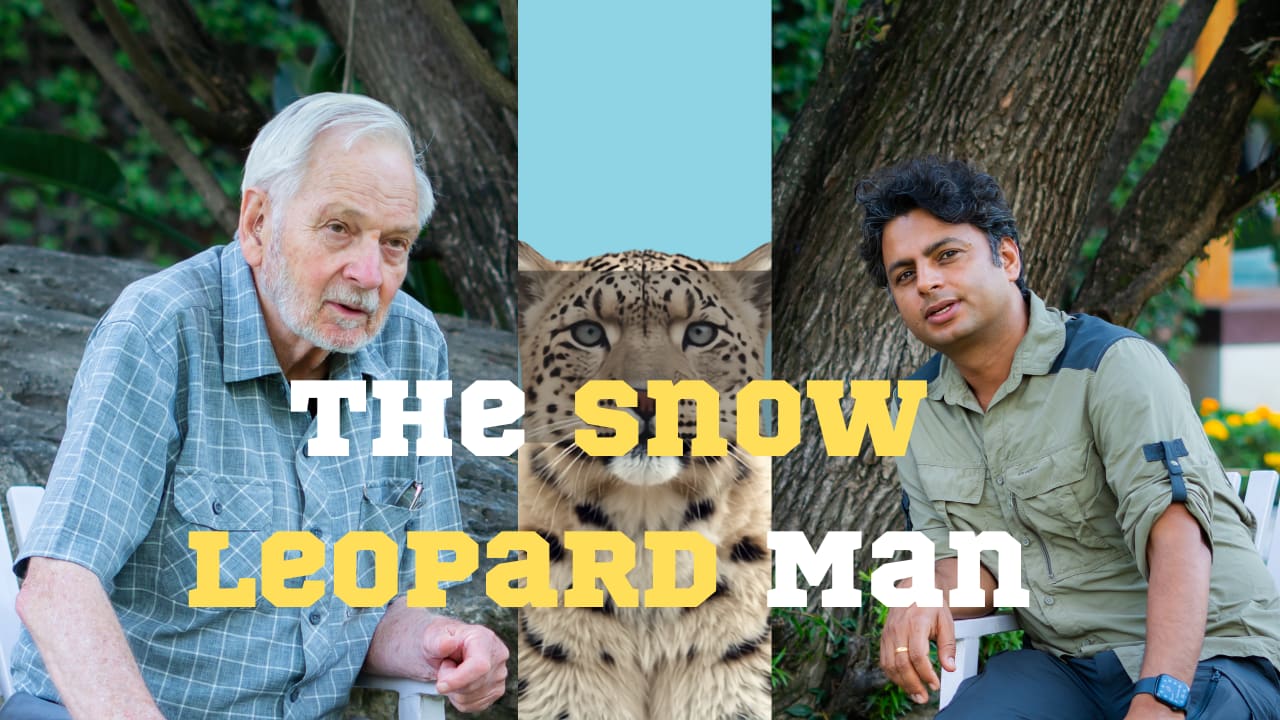
Rodney Jackson is a globally renowned snow leopard expert who first visited Nepal in 1976. As the first person to radio-collar a snow leopard, he has dedicated his life to protecting the species, with Nepal at the heart of his work. He has worked across multiple range countries, spanning from Mongolia to India. At 83, he remains remarkably active as a founder of Snow Leopard Conservancy.
I spoke with Rodney in June while he was in Nepal for the Conservation Biology Asia conference. Nowadays, I am publishing according to my schedule as I am practicing slow journalism.
Ramesh: What brought you to Nepal in 1976, and how did you end up working on snow leopards?
Rodney: In 1976, nobody knew anything about snow leopards. You could write their natural history on a postage stamp. My visit to Nepal was just a side trip on my way back to Africa, where I was born. I had wanted to study the common leopard there, but I came to Nepal instead, where I met incredible people. The Himalayas cannot compare with Africa except for holding a large population of wildlife.
George Schaller had tried to study snow leopards but made limited progress. In 1981, I received the Rolex Award for Enterprise, which funded my radio-collaring work. I had originally hoped to work in Ladakh, but radio-collaring was still new, and governments were cautious about issuing permits. When I visited Mugu district, I knew I had found the right place. There were abundant signs of snow leopards and plenty of blue sheep, though I rarely saw the cats themselves. While there, I also documented a village’s annual winter hunt for meat and musk deer pods, writing a paper on its importance to household income. That paper was published before our telemetry study appeared on the cover of National Geographic.
Ramesh: When did you first see a snow leopard, and how did it feel?
Rodney: It took a long time. My closest encounters were when we trapped them for telemetry, five altogether. The fur was so soft and deep, a beautiful whitish-yellow on the undercoat. Recalling that moment of touching a snow leopard still sends a shiver down my spine. Even seeing one through a scope at three or four hundred meters, they have this intense stare. They look straight through you to see who you are.
Ramesh: After 50 years, what have you come to understand about them?
Rodney: That they move completely unseen yet have a great impact. Like any predator, they hunt what is easiest to kill, and livestock have lost all their anti-predator behavior. Because of that conflict, people saw snow leopards as pests. My goal has been to help communities see them as an asset from which they can benefit.
Ramesh: Why does a snow leopard kill so many animals at once inside a corral?
Rodney: Because the setup is unnatural. In the wild, when it attacks blue sheep, it gets one and the rest scatter. In a corral, the livestock cannot escape. A snow leopard’s hunting behavior is triggered by movement, so whenever something moves, it must attack to immobilize it. It gets caught in a loop of predatory reflex. Killing 30 or 40 goats takes enormous effort, leaving the cat completely out of breath. Then people arrive, see dead sheep and goats with nothing eaten and tooth marks on their throats, and conclude it is an evil animal that sucks blood.
Ramesh: Fifty years on, we still cannot confirm the global population of snow leopards. Is this simply because of the remote terrain, or is politics involved?
Rodney: Frankly, it is a tragedy that we spend so much time worrying about how many snow leopards there are instead of focusing on the impact of conflict. Scientists love numbers, and so do governments. But does it really matter whether there are 200 or 300 in an area? That does not improve conservation. Villagers who are losing livestock and receiving no compensation are not concerned with exact figures. Direct conservation action should have become the priority at least two decades ago.
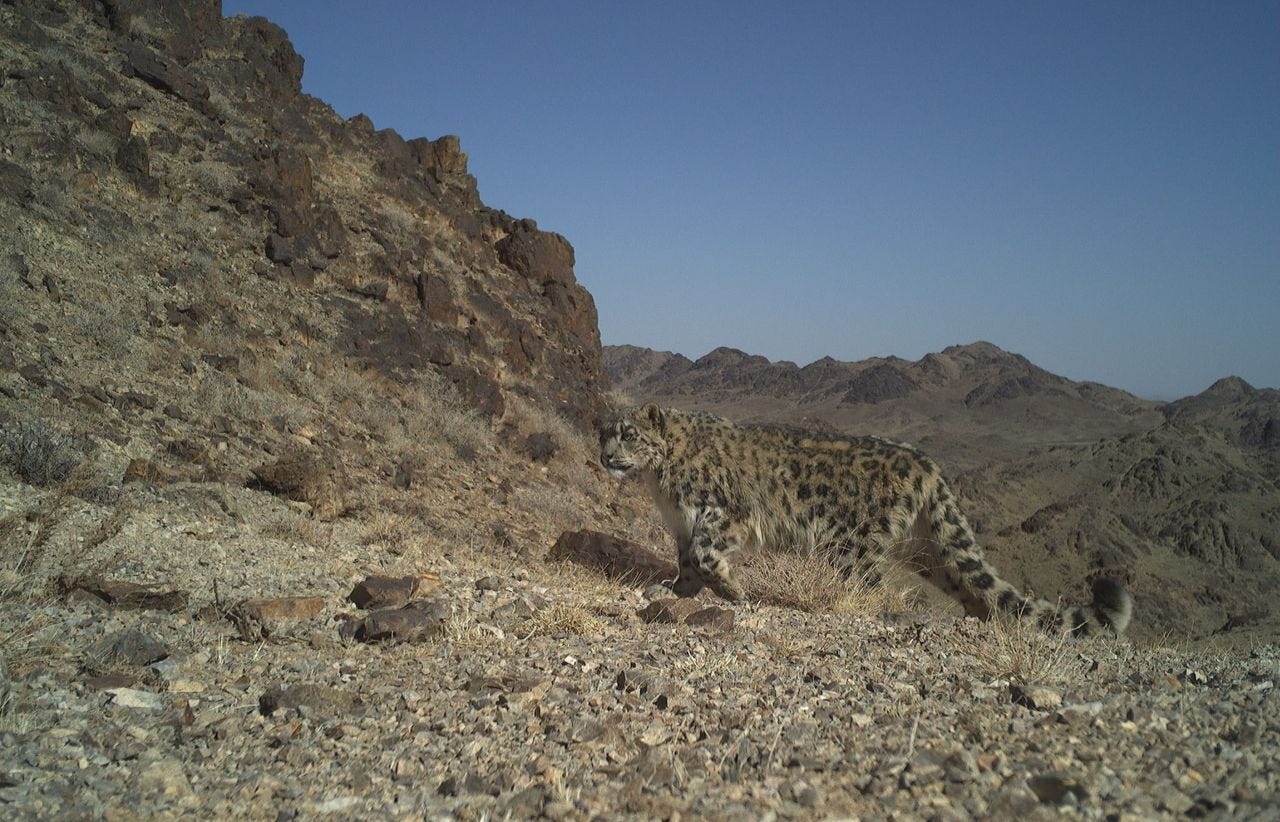
A snow leopard in Mongolia’s South Gobi.Photo Credit: Wildlife Conservation Society
Arriving at a single global estimate is difficult. Sending an international team into every country is nearly impossible because of permits and bureaucracy. It would be far better for in-country researchers to use standardized methods like camera trapping. China remains a major gap because foreign researchers are not allowed to conduct studies there; since 2007, there have been no studies by scientists from outside China. Chinese researchers now estimate their population at about 4,000 (nearly double the figure from the early 2000s), but no peer-reviewed paper has been published to support this.
The reality is that massive resources go into estimating populations, while far too little goes toward protecting communities and reducing conflict. Villagers often know more about when and how conflict occurs than a scientist who sets up a camera and leaves. We need lower-cost programs that actually work. If we stop people from killing snow leopards, their populations will recover on their own.
Ramesh: Do you think new technologies will make population tracking easier?
Rodney: Not much. AI identification is still difficult, and humans are better at it. Many researchers do not follow a systematic analysis from capture to capture or cross-reference to confirm an individual. If you photograph only one side, you do not know who it is. You need both sides, or a way to link them by face or tail patterns, which means placing two cameras facing each other. But snow leopards habitually walk right against a cliff face to keep an escape route, making it tough to capture both sides.
Ramesh: What emerging technology looks promising for monitoring?
Rodney: Camera trapping is still the main tool. Scent and hair posts remain difficult; if two cats visit consecutively and you do not collect the hair immediately, the samples mix and you end up analyzing an “imaginary” leopard that does not exist. Non-invasive scat collection has improved: if you collect in cool temperatures so the DNA does not degrade and verify it is a snow leopard, you can run individual analysis. Drones also have potential. However, the real priority for technology should be conflict detection and mitigation, not counting.
Ramesh: Agencies argue that realistic numbers are the necessary starting point for both science and conservation. Do you agree?
Rodney: I disagree. It does not matter how many there are, as long as they are not on the brink. Sample every three or four years to check for major changes, and usually, you will find them stable or slightly increasing. This obsession with a census has held up practical conservation far too long. It is a political goal for bureaucrats and scientists who want a definitive answer and do not trust simpler methods like talking to villagers, mapping habitat, and looking at blue sheep biomass to see how many cats it can support.
Ramesh: Should the snow leopard be listed as “Endangered” or “Vulnerable” on the IUCN Red List?
Rodney: The push to keep the snow leopard listed as Endangered is mostly about funding, because endangered species attract more donor money. But we need to separate national from global status. Globally, across all 12 range countries, the snow leopard is Vulnerable. In Nepal, however, a population of about 300 animals could still be considered nationally endangered, especially if genetic connectivity across the border with China is lost.
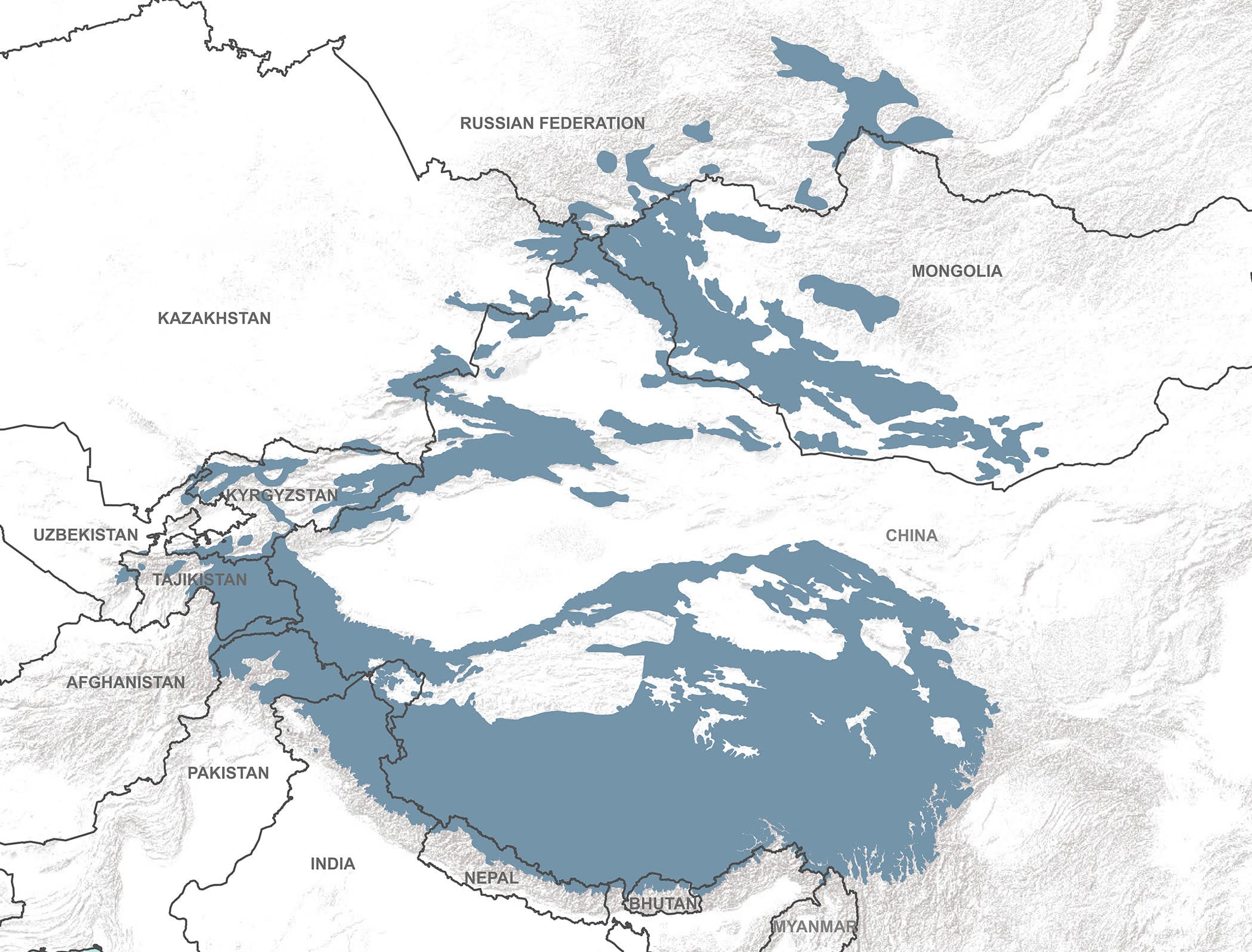
Snow Leopard range map. Image: Snow Leopard Conservancy.
International researchers have not been allowed to work in China since around 2006 or 2007. The research is now done by Chinese scientists, which is technically fine, but highly political. They face pressure to align with leadership statements: if a leader says the numbers have doubled, researchers are expected to support that claim. China now reports about 4,000 snow leopards, up from 2,000 to 2,500, but there is still no peer-reviewed paper. Mongolia has good data, with about 980 animals, which is slightly lower than earlier estimates. However, camera traps are often clustered around scrape sites used during mating, while young dispersing males avoid dominant males and those sites, so they may be missed.
South Asia (India, Nepal, and Pakistan) has more robust and transparent data. Bhutan and India are rigorous, although local researchers sometimes remain skeptical of one another’s models.
Ramesh: Bhutan showed that solar fences doubling as deterrent fox lights and phone-charging stations help reduce conflict. Do you think this is practical for other countries?
Rodney: It can be. However, standard fox lights flash in a fixed pattern, so cats habituate to them quickly. Even randomized flashing fails if the light stays in one spot and nothing ever happens to the predator. I have been encouraging groups to link fox lights and camera traps to a higher-level alert: if a camera detects a leopard lingering for more than five or ten minutes, it triggers a loudspeaker blasting a recording of an angry villager shouting. Snow leopards would react to that. We should also test simple visual barriers, like wrapping thick plastic around corrals. A predator usually will not attack unless it can see its target; if it cannot see inside, it will not jump in blindly.
Ramesh: So, managing conflict requires understanding individual behavior?
Rodney: Exactly. Young males are not very cautious, much like young humans. They take risks and get into trouble. Resident females are usually more careful, but a female with cubs is under real pressure to feed them, so she may take risks too.
That is why I think we need to flip the model. Satellite collars and field biologists are extremely expensive, costing $80,000 to $120,000 a year for a single project. Why not put more of that money directly into reducing depredation? If we reduce the threat, snow leopards will show themselves more. Tourists can come with binoculars; the cat does not need a $5,000 collar around its neck for people to see it.
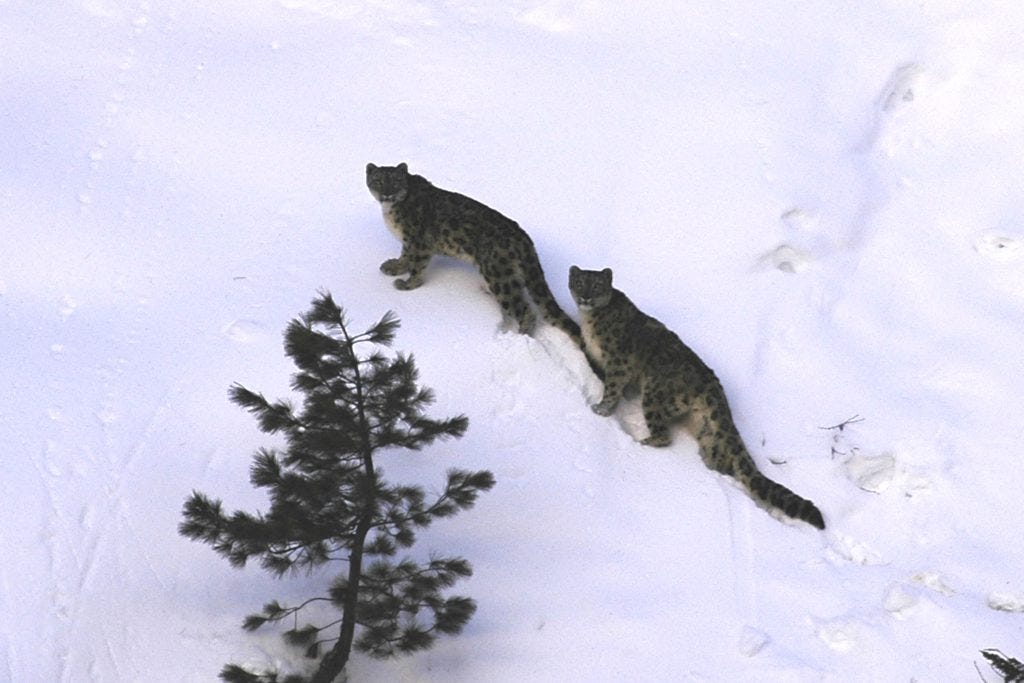
A rare sighting of a snow leopard pair in Manang. Photo from the Snow Leopard Conservancy/Tashi R Ghale
At the moment, a researcher’s career depends heavily on publications. We need to loosen that system and bring villagers in as local observers who can collect and report useful data. Think about a Dolpo village with 50 to 70 households. A team of 30 or 35 people from parks and big NGOs arrives, puts an expensive collar on a snow leopard, and leaves without convincing villagers that their livestock losses will be taken care of. Of course, people get angry. Within weeks, the collared cat may be killed. That happens because we have not shared the process with the community or built local capacity.
Ramesh: Where are we heading in the next 20 years?
Rodney: I feel good about places where conflict is being actively mitigated. When the conflict stops, the cats show themselves, and local youth can track signs, manage tourism, and take visitors out. The snow leopard survives under incredibly harsh conditions in only twelve countries. In 20 years, it is going to become iconic, like the lions of Africa, an animal people across the world want to see.
A decade ago, I had travelled to Manang in northwestern Nepal and interviewed Tashi R Ghale, who has been capturing the ghosts of mountains. He is a citizen scientist, and you can read his interview here.
Great interview, Ramesh. I found it fascinating. It is good to know that something as simple as preventing snow leopards from seeing into livestock corrals could reduce conflict, though I hope there is a better material to use than sheets of plastic.